

03.30.26 - What to watch ahead of reconciliation redux
Republicans in Congress are discussing another go at reconciliation, the wonky process they used to pass last summer’s so-called One Big Beautiful Bill Act (OBBBA). Here’s a quick rundown of how, why, when, and—importantly—whether we really might see those talks turn into action.
The process
For folks who are new to reconciliation: in a nutshell, it’s a process that makes it easier to get bills through the Senate. The Senate’s rules require most bills to get a supermajority of votes (60 out of 100 senators) to pass. The reconciliation process allows senators to expedite some bills’ approval with a simple majority vote (51 out of 100). This makes reconciliation an attractive option for Senate Republicans—who hold a narrow majority with just 53 seats—to pass legislation that lacks Democratic support.
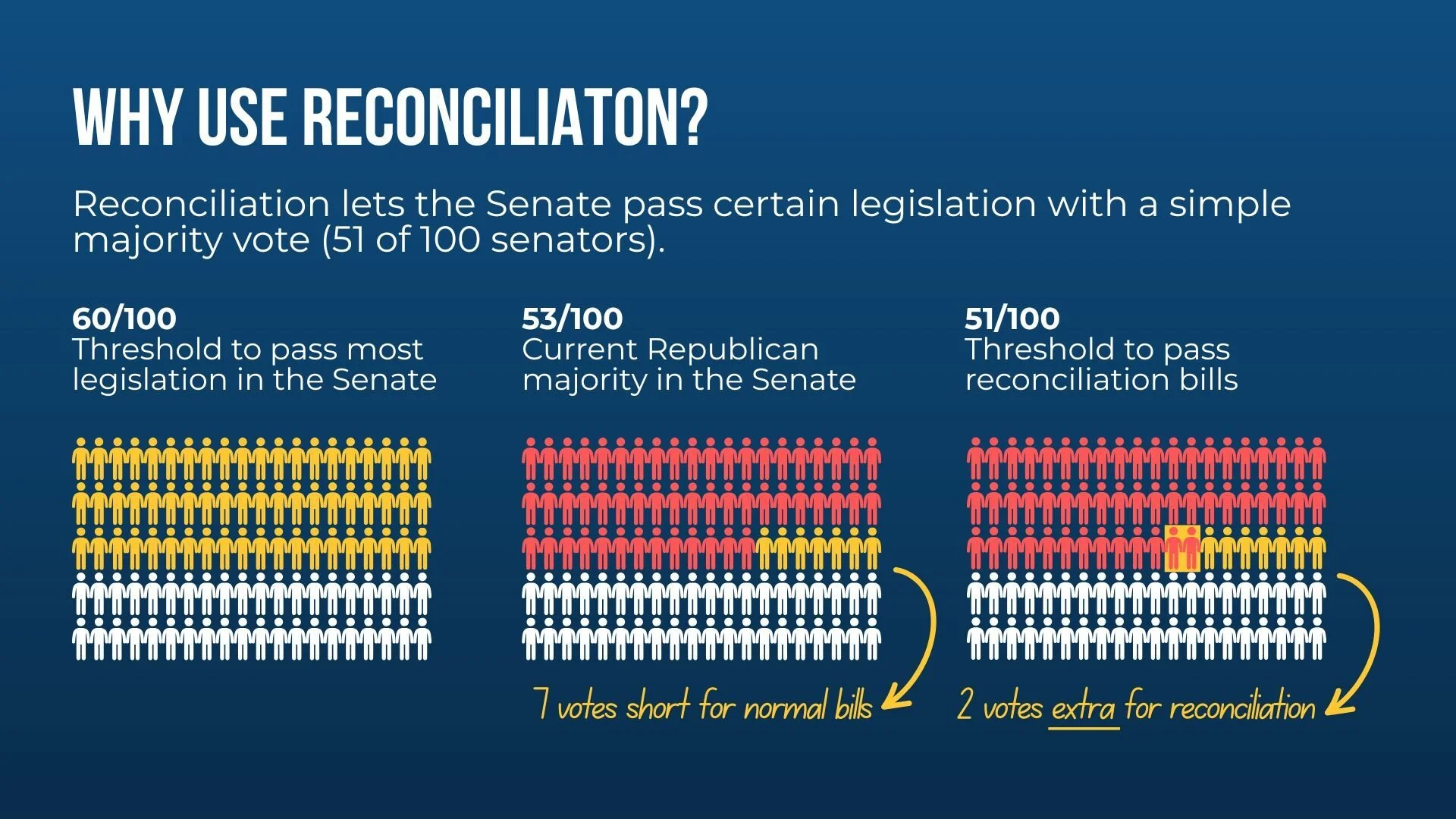
Reconciliation has a lot of rules, but here’s a key one for the purposes of this newsletter: reconciliation bills must affect the federal budget. More specifically, they must change how much money the government spends (expenditures) or takes in (revenues). Those changes cannot be “merely incidental” to the policy changes a bill makes. Put differently: if a specific provision changes a policy and just happens to affect the federal budget, the provision may be thrown out.
For a more detailed overview of the reconciliation process, check out The Basics of Budget Reconciliation.
The goal
Republicans have raised reconciliation as a way to advance several policies that lack adequate Democratic support to get through the Senate. The ones that come up most often are:
Funding for Immigrations and Customs Enforcement (ICE) and Border Patrol, possibly for the next three years. This would come on top of last summer’s OBBBA, which allocated an extra $170 billion for immigration enforcement—paid for by cuts to health care and food assistance.
Funding to continue the U.S.-Israel war on Iran, potentially in excess of $200 billion. For context, the same funding could cover free lunch for every American child, tariff refunds for every American household, reverse Republicans’ OBBBA cuts to Medicaid and food assistance, and much more.
Republicans’ voter suppression bill. The so-called SAVE America Act would make it harder for all Americans to register to vote, disproportionately affecting people of color, married women, and young people.
Many Republicans want to see new funding offset with corresponding cuts. Indeed, some GOP leaders have already floated health care cuts to pay for the Iran War.
The timeline
The first step in the reconciliation process is passing a budget resolution. Republicans haven’t done that yet. On average, reconciliation bills passed over the last 25 years have taken 179 days to become law after the budget resolution teeing them up passes.
Congress is scheduled to return to Washington on April 14. Let’s assume, for the sake of argument, that they adopt a budget resolution very quickly: the Friday of that week, April 17.
Even if Congress works that fast—and there’s no indication they will—and then uses the average of 179 days to work through the reconciliation process, the resulting bill will be signed into law on October 13. That’s less than a month before the midterm elections, and 12 days after Members are slated to return to their districts to campaign.
That brings me to my next point…
The prognosis
Let’s start with the odds that Republicans can use reconciliation for all three items on the agenda above: ICE, Iran War, and voter suppression.
Recall the requirement for reconciliation bills to deal primarily with budgetary matters. While funding for ICE and the Iran War adhere to that rule—funneling money to something has a clear budgetary impact—voter registration policies could be a harder sell, and Republicans are already talking about how to bypass the requirement. Senate GOP Leader John Thune said Republicans would ultimately defer to the Senate parliamentarian’s ruling on which policies pass muster under reconciliation’s rules. So, whether Republicans can accomplish all of these goals via reconciliation is still TBD.
Will Republicans use reconciliation for these priorities is a different question altogether.
Again, even a generous estimate has them wrapping up the process after they want to be home campaigning. It’s also right around the time government funding expires (September 30), meaning yet another possible government shutdown. And, finally, it’s worth considering the optics: do Republicans in Congress want to surge taxpayer dollars to fund a war Americans widely oppose, and risk more headlines like “GOP weighs health care cuts to pay for Iran war”, right before an election?
We’ll continue to keep you posted as the answer becomes clearer.
If you’d like a live update for your group or coalition, reach out to catherine@webuildprogress.org. Thanks!