

07.15.26 - What we know about reconciliation 3.0
The Republican-controlled House of Representatives has teed up another run at reconciliation, the process that allows Congress to pass certain legislation with a party-line vote. Recall that the GOP-controlled Congress already has two reconciliation bills under its belt: last summer’s so-called One Big Beautiful Bill Act, and June’s narrower package that funneled an extra $70 billion to the President’s mass deportation machine.
Below, we walk through the details we know so far. For a broader overview of the reconciliation process, check out A Visual Guide to Reconciliation.
What will be in this next reconciliation bill?
This morning, House Republicans released a budget blueprint directing specific House committees to write parts of the reconciliation bill, dictating how much each of those committees can change government spending or revenue, and setting a deadline by which the committee must share their part of the bill with the House Budget Committee.
Here’s a cheat sheet for those instructions:
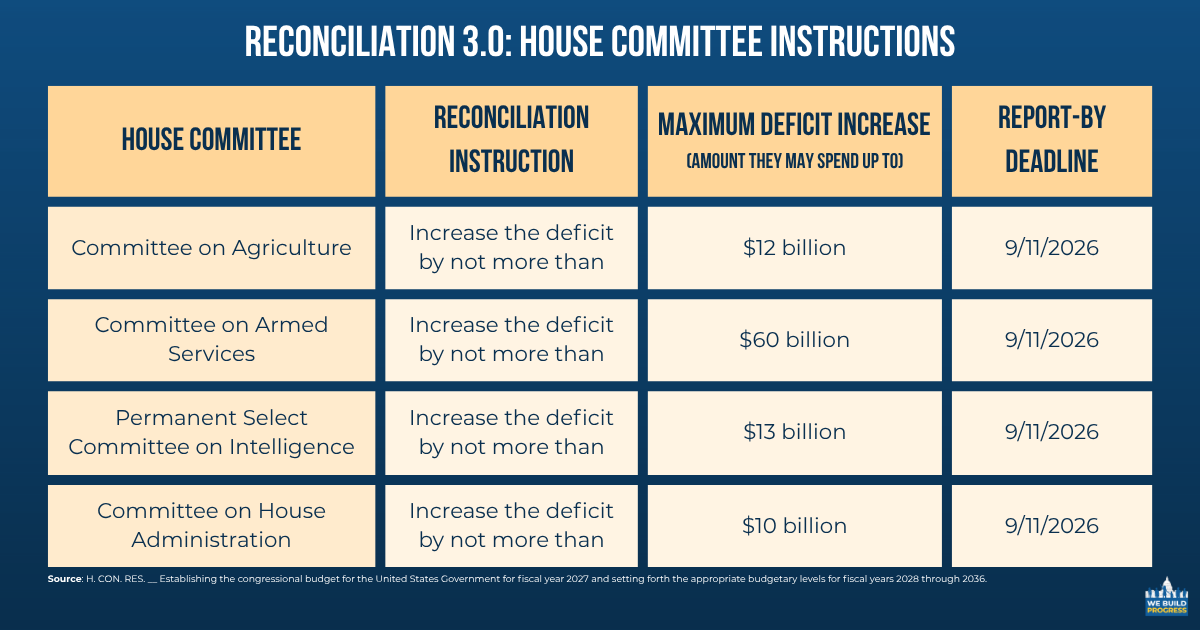
In telling specific committees to write parts of the bill, the budget resolution defines the universe of topics the bill can possibly cover. The final bill is only going to include policies that fall under those committees’ jurisdiction. Here’s a good summary of every congressional committee’s jurisdiction.
Secretary of Defense Pete Hegseth, Joint Chiefs of Staff Chairman Dan Caine, and Secretary of Agriculture Brooke Rollins will appear before Senate appropriators next week, during which they’ll presumably share more about how they’d use the funding in this reconciliation bill. For now, here are my high-level takeaways from today’s budget resolution:
The biggest chunk of money by far goes to Armed Services, likely meaning this bill would primarily fund the war on Iran. Recall that this war—which has killed more than 7,300 people in Iran and Lebanon and 14 U.S. servicemembers—has not been authorized by Congress, in contravention of the Constitution.
The $10 billion for House Administration likely means money for states’ voter suppression efforts. At least, that’s what reporting suggests. While the broader Trump-backed SAVE America Act can’t pass muster under reconciliation’s strict rules, this funding could be an effort to placate that bill’s loudest backers. Whether that effort works is yet to be seen.
The tax and health care committees aren’t mentioned. Neither are the major immigration committees. The absence of Ways and Means, Energy and Commerce, and Education and Workforce means we won’t see major health care and tax changes in this bill. Same goes for the big immigration committees, Homeland Security and Judiciary—without them, we won’t see another huge infusion to immigration enforcement agencies.
It’s not clear if new spending will be offset. Failure to offset new spending could present a problem for fiscally conservative hardliners—but it’s not necessarily a dealbreaker. It could just take Republicans extra time to navigate those tensions.
Where are Republicans in the reconciliation process?
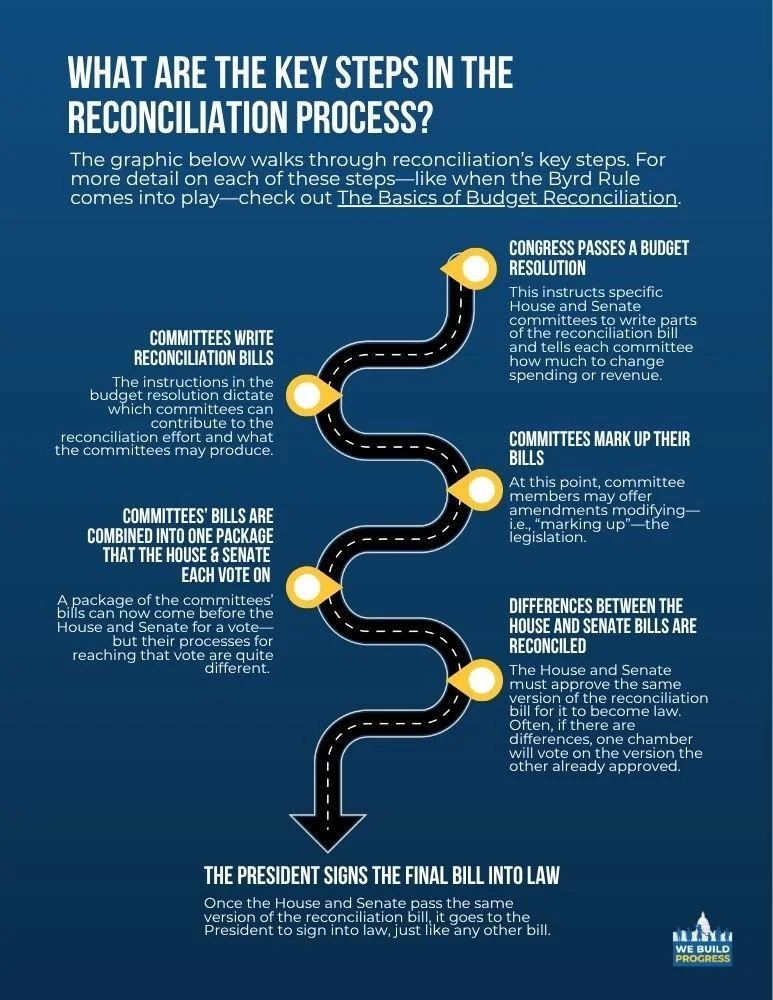
The resolution introduced today has yet come before the House or Senate—the real first step in kicking off this process. House Republicans hope to mark this resolution up in the Budget Committee tomorrow (July 16) and get it to the House Floor next week, but no word on the Senate’s plans. The graphic below gets into the steps still ahead.
Can Republicans actually get this done?
That’s a whole other question. Today’s Punchbowl summarizes some of the hurdles ahead well. We’ll keep you posted as more becomes clear.
If you’d like a live update for your group or coalition, reach out to catherine@webuildprogress.org. Thanks!